
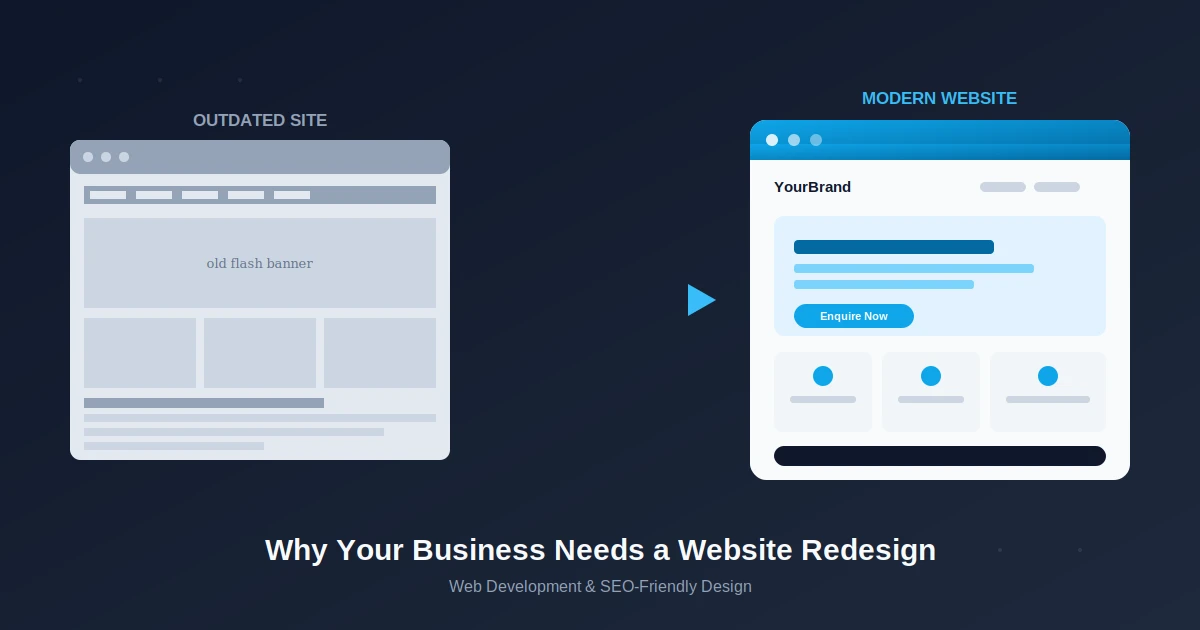
I know a guy who runs a fabrication business near Kakkanad. Good work, decent pricing, solid reputation among people who’ve actually worked with him. But his website? Built around 2015, never touched since. When I pulled it up, the layout still shifted on my phone, the contact number was on a page three clicks deep, and there was a “Flash-based gallery” note staring back at me that hadn’t loaded anything in probably five years. He wasn’t losing customers because his work was bad. He was losing them before they even picked up the phone.
This happens more than people think. A business grows, the owner gets busy with actual operations, and the website just… sits there. Nobody notices until someone mentions it, usually a customer who left without saying why.
What an old website actually costs you
It’s not one big dramatic failure. It’s a bunch of small annoyances stacking up.
Take user experience first. Old sites tend to have cramped menus, tiny buttons, text that’s hard to read, sections that don’t quite make sense anymore because someone added a “new” service page five years ago and never redesigned around it. None of this is catastrophic on its own, but visitors don’t stick around to work through confusion. They just leave.
Then there’s mobile. This is probably the biggest one honestly. Most people browsing your site right now are doing it from their phone, not a desktop. If the site wasn’t built with that in mind, things get messy fast — text overflowing, buttons too close together to tap accurately, images that don’t resize. People notice this within seconds, and they don’t forgive it.
Speed matters too, and older sites are often slow without anyone realizing why. Maybe it’s using outdated code, maybe it’s hosting on cheap servers, maybe nobody ever compressed the images. Whatever the reason, a few extra seconds of load time is enough for someone to hit back and go check a competitor instead.
There’s also the trust factor, which is harder to quantify but very real. A dated design makes people wonder, even subconsciously, whether the business is still around or taken seriously. It’s unfair sometimes — plenty of great businesses have neglected websites — but that’s how people judge things online. First impression, no context.
SEO takes a hit too. Search engines have gotten pretty particular about site speed, mobile compatibility, structure, security — all things an outdated website usually fails at without the owner even knowing. So even if your business is doing well offline, your visibility online can be quietly dropping.
And obviously, all of this eventually shows up as fewer enquiries. If the contact form is buried, if there’s no clear next step for visitors, if the whole site just feels dated and slow — people leave without reaching out, even the ones who were genuinely interested.
Your brand takes the hit last but maybe worst. The website is often the first real impression someone gets of your business, before they ever talk to you. An old, clunky site undersells everything else you’ve built.
So when does a redesign actually make sense
Honestly, there’s no fixed timeline — it depends on how the site is performing and how it looks compared to what your customers are used to seeing elsewhere. But usually it’s some combination of things: the site looks visibly dated, it doesn’t work properly on phones, it’s slow, or enquiries have quietly dropped without an obvious reason.
This is usually the point where businesses start looking seriously at website redesign and proper web development rather than just patching things up. Not because redesigning is trendy, but because the old setup genuinely isn’t doing its job anymore.
What a modern business website needs
A good website today isn’t just about looking sleek. It needs to function well and actually support what your business is trying to do. A few things that matter most:
Responsive design, so the layout adjusts properly whether someone’s on a laptop, tablet, or phone — not just “technically works” but actually looks right.
A mobile-first approach, since that’s where most of your visitors are coming from anyway.
Fast loading. This one’s non-negotiable at this point. Every extra second costs you visitors.
Navigation that makes sense without thinking. If someone has to hunt for basic information, something’s wrong.
A clear call-to-action. Whatever you want visitors to do — call, message, book, buy — make it obvious, not buried in a paragraph somewhere.
SEO-friendly structure underneath all of it, meaning clean code and pages built in a way search engines can actually read properly.
Security basics like HTTPS, because browsers flag insecure sites and people notice.
A content management setup that doesn’t require calling a developer every time you want to change a price or add a photo.
And design that’s actually built around conversions, not just visuals — meaning every page is quietly nudging visitors toward doing something, not just sitting there looking nice.
Where a website development company fits in
Here’s the thing — most business owners know their business really well and know very little about how websites actually work under the hood. That gap is exactly where a website development company earns its keep.
A decent one won’t just slap a new template on your old content and call it done. They’ll actually look at what’s not working, understand what your business needs from the site, and build around that — speed, structure, security, mobile performance, all of it working together instead of being an afterthought.
If you’re based here in Kerala, there’s a real advantage to working with a web development company in Kochi specifically. They understand the local market, they’re reachable without time zone gymnastics or endless email chains, and they tend to actually understand who your customers are because they’re dealing with similar businesses regularly. Whether you’re running a small service business or something with a dozen product pages, a web development company in Kochi can usually offer more hands-on involvement than a distant agency juggling clients across different markets.
One honest note though — a redesign by itself won’t magically fix your enquiries or sales numbers. It’s not a guarantee, and anyone who tells you otherwise is oversimplifying things. What it does is remove the friction that was probably pushing people away before they even got to know your business properly. The rest still depends on everything else you’re doing.
Bottom line
An outdated website rarely announces itself as a problem. It just sits there, quietly underperforming, and you don’t really notice the cost until you look closely — slower loading, fewer enquiries, visitors bouncing off without a word. If any of this sounds familiar, it might be worth having a proper look at where your site stands and what an updated version could actually do for you.